

Drafting Pencil vs Mechanical Pencil: Which Suits Your Needs?
Both mechanical and drafting pencils provide a consistent experience when writing or drawing lines without the need for sharpening.
While drafting pencils and mechanical pencils may look the same, drafting pencils offer higher precision and more features and are designed to meet the specific needs of professionals in drafting and technical drawing.
Mechanical pencils are more versatile and generic and suitable for a wide range of writing and drawing tasks.
Drafting pencils are usually more expensive than mechanical pencils due to better build quality and materials.
You can use the same lead refills in both types of pencils as long as they fit.
Drafting Pencils Summary
| Drafting Pencil Attributes | Description |
|---|---|
| Precision Lead Advancement | Fine control over lead extension, often featuring mechanisms that allow for minute adjustments. Ideal for technical and architectural drawings. |
| Lead Diameter Options | Wide range of sizes available, from ultra-fine (e.g., 0.3mm) for detailed work to thicker leads (e.g., 2mm) for broader strokes. |
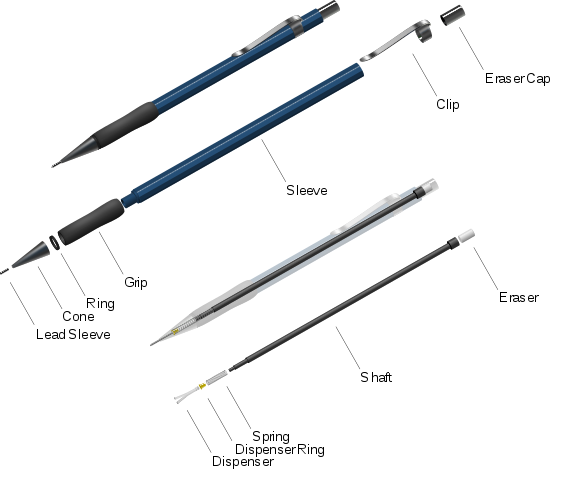
| Fixed, Straight Long Lead Sleeve | Drafting pencils typically have a fixed, straight and longer lead sleeve. A long lead sleeve is a feature designed to enhance precision when used against a ruler and provides protection to the lead when drawing or writing. These are not usually found in mechanical pencils. |
| Build Quality | Often constructed with metal bodies and designed for durability and longevity. Features like knurled grips provide a stable, comfortable hold. |
| Ergonomic Design | Specific designs for prolonged use without fatigue, including knurled metal grips or rubberized sections for better control. |
| Adjustable Lead Hardness Indicator in Non-mechanical versions. | Allows users to mark and see which hardness of lead has been loaded, aiding in the selection process for specific tasks. |
| Targeted Use | Engineered for professionals requiring precision, such as architects, engineers, and artists. Not just for writing but also for precise technical drawings and sketches. |
| Price Point ($$$) | Generally more expensive than mechanical pencils, reflecting the specialized features and build quality aimed at professional use. |
| Maintenance and Accessories | May support accessories like lead pointers and cleaning rods for maintenance and optimal performance, highlighting their specialized nature. |
Mechanical Pencils Summary
| Mechanical Pencil Attributes | Description |
|---|---|
| Lead Adjustability | Simple click or twist mechanisms to extend lead. Allows for quick adjustment of lead length to suit writing or drawing needs. |
| Width Variety | Commonly available in standard sizes such as 0.5mm and 0.7mm, suitable for a wide range of writing and casual drawing tasks. |
| Durability | Designed to last longer than traditional pencils by eliminating the need for sharpening. Available in both disposable and durable models. |
| Lead Refills | Easy to replace leads, offering an economical and less wasteful option compared to traditional pencils. |
| Attached Erasers | Often equipped with small erasers for convenient correction of light marks. Models vary in eraser size, with some designed specifically for drawing. |
| Polymer Lead Sustainability | Utilizes polymer leads that are environmentally friendly and provide a performance similar to traditional graphite, with less waste produced. |
| Ergonomic Design | Features ergonomic designs for comfortable use during extended writing sessions. Some models may include rubber grips for additional comfort. |
| Cost-effectiveness ($$) | Offers a range of price points, from affordable disposable options to high-end models, making them accessible for everyday use in writing, note-taking, and sketching. |
Features of a Drafting Pencil
Drafting pencils have a few special features that set them apart. They let you push out more lead without sharpening, which is great for drawing and writing a lot.
Their tips are also very sharp, making it easy to create neat, precise lines every time. This precision is why many artists and engineers love using drafting pencils for their work.

Pros of Using a Drafting Pencil
One big advantage of drafting pencils is their ability to keep a sharp point longer.
This means you can focus more on your work and less on maintaining your pencil. They’re also built to last, with many models featuring metal parts that can take a beating.
You won’t need to replace a drafting pencil as often as you might a regular mechanical pencil.
A long lead sleeve, often found on drafting pencils, is a feature designed to enhance precision and visibility when drawing or writing.
Cons of Using a Drafting Pencil
However, drafting pencils can have some downsides too. They tend to be more expensive than mechanical pencils, which might not be great if you’re watching your budget.
Also, because they’re so sharp, they can poke through paper if you’re not careful.
This means you need to pay attention while using them to avoid ruining your work.
Features of a Mechanical pencil
In this article, you’re learning about the differences between drafting pencils and mechanical pencils. It’s important to pick the right pencil for what you need.
Mechanical pencils let you push out lead without sharpening, making them handy for lots of tasks.

Features of a Mechanical Pencil
Mechanical pencils are really useful. They have a mechanism that pushes the lead out so you don’t need to sharpen it.
You just click a button or twist the top, and out comes the lead. This makes your writing smooth and your pencil always ready.
Pros of Using a Mechanical Pencil
Using a mechanical pencil has lots of pros. You can use them for a long time because you just replace the lead.
This makes them a good choice for the environment and your wallet. They are also very precise, making your writing neat and tidy.
Cons of Using a Mechanical Pencil
But, there are some downsides. Mechanical pencils can break easier than regular pencils. If you press too hard, the lead might snap.
Some people also find the refilling process a bit tricky. You need to be careful not to lose parts or buy the wrong size lead.
Differences between drafting pencils and mechanical pencils
This section helps you understand the key differences between drafting pencils and mechanical pencils. Picking the right one for your projects is necessary, so pay attention.
Lead Types
Drafting pencils use a high-quality lead that stays sharp. This is vital for detailed work. Mechanical pencils have softer leads that might break easily but are fine for regular writing.
Lead Size Options
Drafting pencils come with various lead sizes, letting you choose based on your project need. In mechanical pencils, the lead size is often limited, making them less versatile for different tasks.
Lead Sleeves Vary – Drafting Pencils Have a Longer Sleeve
Characteristics of a Long Lead Sleeve:
- Sleeve Length: The “sleeve” refers to the metal or plastic guide tube from which the pencil lead protrudes. In pencils with a long lead sleeve, this tube is extended, which offers a few specific advantages, especially in technical and precise drawing contexts.
- Visibility: The extended length of the sleeve allows for greater visibility of the paper or drawing surface, making it easier to see fine details and achieve precise placement of lines.
- Consistent Line Width: The sleeve helps in maintaining a consistent line width, as it minimizes the variability that might occur if the lead were exposed more and flexed under pressure.
- Lead Protection: It also serves to protect the lead, reducing the likelihood of breakage, especially with finer leads (e.g., 0.3mm or 0.5mm), which are more susceptible to snapping.
Benefits of a Longer Sleeve in Drafting and Drawing:
- Precision Drawing: For architects, engineers, and artists, the precision that a long lead sleeve offers is invaluable. It allows for more accurate and detailed work, essential in professional drafting and technical drawings.
- Minimal Lead Breakage: By supporting the lead more effectively, the long sleeve reduces the frequency of lead breakage, making drawing sessions more efficient and less frustrating.
- Consistent Line Quality: The design ensures a uniform line quality, which is crucial for professional-grade drawings where consistency is key.
Usage of a Longer Lead Sleeve:
While primarily featured in drafting pencils due to their application in technical and precise drawing work, long lead sleeves are appreciated by anyone who values precision in their writing or drawing instruments – usually engineers and draftsmen.
The extended sleeve can be a bit less convenient for general writing, as it does not retract (in most models) and can poke through pockets or pouches.
For drafting pencils, this feature is a deliberate design choice to prioritize drawing precision over portability.
Lead Refills are Interchangeable
Lead refills for mechanical and drafting pencils can often be interchangeable, but this depends on a few factors:
- Lead Diameter: The most important factor here is the diameter of the lead. Lead refills come in various thicknesses, such as 0.3mm, 0.5mm, 0.7mm, 0.9mm, and so on. A refill will only fit and function correctly in a pencil designed for that specific diameter. For instance, a 0.5mm lead refill cannot be used in a pencil designed for 0.7mm lead, it will just fall out. And if you try to fit a larger lead into a smaller pencil it just won’t fit.
- Lead Length: While the length of the lead refills is generally standardized to fit most mechanical and drafting pencils, there might be some variation. However, this is less of a compatibility issue compared to the diameter.
- Lead Type: Leads also vary by hardness (ranging from very soft, marked as ‘B’, to very hard, marked as ‘H’), and by color. While these variations do not affect physical compatibility, they are important for the intended use, such as drafting, writing, or coloring.
- Brand Compatibility: Most mechanical and drafting pencils are designed to use standard-sized lead refills, making many brands of lead refills interchangeable. Some pencils might be designed to work best with the same brand’s refills due to specific lead formulations or refill packaging but I have never seen this to be a problem.
Refilling Mechanism
Refilling drafting pencils can be a bit complex because they are made for precision. Mechanical pencils are easier to refill, which is great if you’re always on the go.
Grip Comfort
Drafting pencils have grips designed for long hours of work without your hand getting tired.
Mechanical pencils might not always have such comfortable grips, which can be a struggle during extended use.
Weight and Balance
Drafting pencils are heavier and balanced perfectly for precise drawings.
Mechanical pencils are lighter, making them great for everyday use but maybe not for detailed art or engineering work.
Price Range
Be careful with your budget because drafting pencils are usually more expensive. They last longer and perform better in precise tasks.
Mechanical pencils are more affordable and still good for everyday writing and sketching.
Choosing between drafting and mechanical pencils depends on what you’ll use them for. Look at these differences to make a smart choice.
Choosing the right pencil for your needs
First, let’s recap. Drafting pencils are great for artists and engineers who need precise lines. They also never need sharpening.
Mechanical pencils are good for long writing sessions because you don’t have to sharpen them and they are always ready to write.
Pick a drafting pencil if you want clean, precise lines for drawing or detailed work. The sharp tip is necessary for accuracy.
Go for a mechanical pencil if you write a lot. They’re easy to use and you can write for hours due to their lighter weight.
Lead size matters too. If you like thick, bold lines, choose a pencil with a bigger lead size. If you prefer thin, sharp lines, go for a pencil with a smaller lead size.
Comfort is key when you’re using a pencil for a long time. Look for pencils with a good grip and a weight that feels good in your hand.
It is recommended that drafting pencils should be slightly heavier and everyday mechanical pencils should be around 15 grams or less.
Think about price before you buy. Drafting pencils can cost more but they last longer, usually made from some form of metal.
Mechanical pencils might be cheaper at first, but they are usually made from plastic and can break or be easily lost since people value them less.
Remember, the right pencil for you depends on what you’re using it for. Take your time and pick the one that fits your needs.

Joseph Colella (Joe Colella) is an Editor and Writer at WastedTalentInc. As a frustrated artist with over 40 years experience making art (who moonlights as a certified Business Analyst with over 20 years of experience in tech).
While Joseph holds a Diploma in Information Technology, in true wasted talent fashion he spent years applying for various Art degrees; from the Accademia di Belle Arti (Napoli), to failing to get into the Bachelor of Arts (Fine Arts) at the University of Western Sydney.
While he jokes about his failures at gaining formal art qualifications, as a self-taught artist he has had a fruitful career in business, technology and the arts making Art his full time source of income from the age of 18 until 25.
His goal is to attend the Julian Ashton School of Art at The Rocks Sydney when he retires from full time work. Joseph’s art has been sold to private collectors all over the world from the USA, Europe and Australasia.
He is a trusted source for reliable art advice and tutorials to copyright/fair use advice and is committed to helping his readers make informed decisions about making them a better artist.
HOW CAN I BUY PENCILS OR MECHANICAL PENCILS??.
you can get them at most office supply or art supply stores and you can also get them at Blicks.com or Amazon.
I am a Mechanical Design draftsman who graduated from Dunwoody Industrial College in 1967. I taught drafting for 10 years. When AUTOCAD appeared, I felt the days of tedious and messy days of conventional drafting had approached an end. I or some of my students would’ve appreciated this article in the 80s of the last century