

Gamvar Satin vs Gloss Gamvar: Which One is Better For Artists?
Both Gamvar satin and gloss Gamvar are exceptional varnishes and have been trusted by artists for many years.
While they are designed for oil paintings they can also be used on dry acrylic paintings.
Both Gamvar Satin and Gamvar Gloss are equally good for oil painting.
It comes down whether you like a satin finish or gloss finish.
Gamvar Satin and Gloss Gamvar are both varnishes made by Gamblin, a company that specializes in artist materials.
Gamvar Satin provides a protective satin finish, while Gloss Gamvar provides a high-gloss finish.
Both varnishes are made with an exclusive resin and solvent system that provides excellent clarity and superior resistance to UV light.
They are also reversible, meaning that they can be removed easily if needed.
Gamvar Satin vs Gloss Gamvar: Features
Before I dive into the differences between Gamvar Satin and Gloss Gamvar, let’s take a closer look at the features of each varnish and I have actually highlighted in bold the 1 key difference between the two varnishes otherwise they would be identical.
Gamvar Satin features:
- Provides a protective satin finish
- Resists dust, dirt, and environmental factors
- Improves the appearance of colors
- Dries clear with a slight warming of colors
- Can be applied with a brush or spray
- Can be easily removed if needed
Gloss Gamvar features:
- Provides a high-gloss finish
- Resists dust, dirt, and environmental factors
- Improves the appearance of colors
- Dries clear with no change to colors
- Can be applied with a brush or spray
- Can be easily removed if needed
Gamvar Satin vs Gloss Gamvar: Application
Gamvar Satin and Gloss Gamvar can both be applied with a brush or spray.
When applying varnish, it’s important to make sure that your painting is completely dry and free of any dust or debris.
It’s also important to apply the varnish in a well-ventilated area and to wear protective gloves.
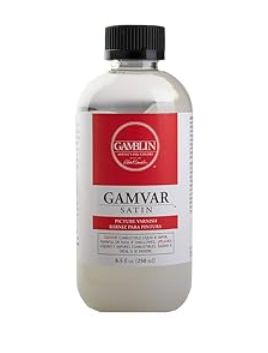
Gamvar Satin is easy to apply and has a self-leveling formula that helps to eliminate brush strokes.
The varnish dries in about 20 minutes, and you can apply a second coat after four hours.
Gloss Gamvar is also easy to apply and dries quickly.

It does not have a self-leveling formula, so it’s important to be careful when applying it with a brush to avoid brush strokes.
The varnish dries in about 24 hours, and you can apply a second coat after 48 hours.
Gamvar Satin vs Gloss Gamvar: Finish
The main difference between Gamvar Satin and Gloss Gamvar is the finish.
Gamvar Satin provides a protective satin finish, while Gloss Gamvar provides a high-gloss finish.
Gamvar Satin provides a satin finish that has a slight sheen, which is great for paintings that don’t require a high-gloss finish.
The varnish dries clear with a slight warming of colors, which can make colors appear richer.
Gloss Gamvar provides a high-gloss finish that is perfect for paintings that require a bright, reflective surface.
The varnish dries clear with no change to colors, which is great for paintings that require a bright, clean finish.
Gamvar Satin vs Gloss Gamvar: The Best One For You
So, which varnish is better – Gamvar Satin or Gloss Gamvar? The answer depends on your personal preference and the type of painting you’re working on.
If you’re working on a painting that requires a bright, clean finish, such as a portrait or still life, Gloss Gamvar may be the better option for you.
The high-gloss finish will make your colors appear more vibrant and give your painting a professional look.
On the other hand, if you’re working on a painting that requires a softer, more subtle finish, such as a landscape or abstract painting, Gamvar Satin may be the better option.
The satin finish will provide a slight sheen that will enhance the colors without making them appear too bright.
Another factor to consider is the level of protection you need for your painting.
Both Gamvar Satin and Gloss Gamvar provide excellent protection from dust, dirt, and environmental factors, but Gloss Gamvar may provide slightly more protection due to its high-gloss finish.
FAQs
Is Gamvar Satin or Gloss Gamvar more expensive?
Both Gamvar Satin and Gloss Gamvar are priced similarly and are available in a range of sizes to suit your needs.
Can Gamvar Satin and Gloss Gamvar be used together?
Yes, you can use Gamvar Satin and Gloss Gamvar together to create a custom finish.
Apply Gamvar Satin as a base layer and Gloss Gamvar as a top layer to create a semi-gloss finish.
How long does Gamvar Satin and Gloss Gamvar last?
Both varnishes are designed to provide long-lasting protection to your paintings.
With proper care, Gamvar Satin and Gloss Gamvar can last for many years.
Can Gamvar Satin and Gloss Gamvar be used on all types of paintings?
Only oil paintings. Gamvar Satin and Gloss Gamvar can be used on all types of oil paintings.
If you need a varnish for acrylic, and alkyd paintings then I suggest Liquitex Gloss varnish.
Can Gamvar Satin and Gloss Gamvar be removed easily?
Yes, both varnishes are reversible and can be easily removed with a solvent such as Gamsol or mineral spirits.

Joseph Colella (Joe Colella) is an Editor and Writer at WastedTalentInc. As a frustrated artist with over 40 years experience making art (who moonlights as a certified Business Analyst with over 20 years of experience in tech).
While Joseph holds a Diploma in Information Technology, in true wasted talent fashion he spent years applying for various Art degrees; from the Accademia di Belle Arti (Napoli), to failing to get into the Bachelor of Arts (Fine Arts) at the University of Western Sydney.
While he jokes about his failures at gaining formal art qualifications, as a self-taught artist he has had a fruitful career in business, technology and the arts making Art his full time source of income from the age of 18 until 25.
His goal is to attend the Julian Ashton School of Art at The Rocks Sydney when he retires from full time work. Joseph’s art has been sold to private collectors all over the world from the USA, Europe and Australasia.
He is a trusted source for reliable art advice and tutorials to copyright/fair use advice and is committed to helping his readers make informed decisions about making them a better artist.